
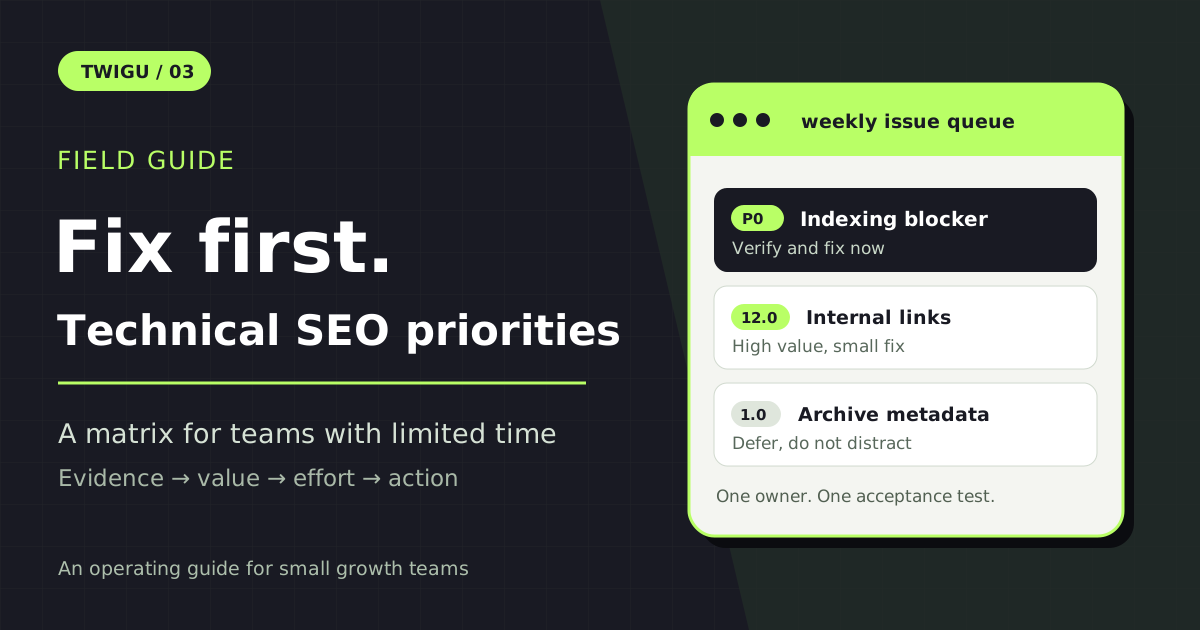
A crawl can produce hundreds of warnings in minutes. A small team cannot fix them all this week, and it should not try. One accidental noindex on a core service template can be more important than fifty duplicate descriptions on pages nobody needs in search. The number of rows is not the size of the business problem.
This guide gives you an issue-level queue, not another list of generic “SEO best practices.” It is for a marketing lead and developer who have a crawl export, Search Console access, and limited implementation time. The result is a short backlog with evidence, an owner, and an acceptance test for each fix. The scoring method below is our planning rubric, not a Google score or a prediction of traffic gains.
First, separate eligibility blockers from improvements
Before scoring anything, identify intended search pages that may not be eligible for indexing. Google’s technical requirements are narrow: Googlebot must not be blocked, the page must work with a successful response, and it must contain indexable content. Meeting those conditions still does not guarantee indexing. An important page with an accidental noindex, a persistent server error, or access blocked by authentication needs immediate investigation regardless of how many points a spreadsheet gives it.
Make one exception explicit: an exclusion can be correct. A thank-you page, a removed offer, or a duplicate URL does not become a defect just because a tool colors it red. Google’s Page indexing report guide advises checking whether a non-indexed URL was meant to be indexed in the first place. If not, document the decision and keep it out of the fix queue.
Use a simple gate:
| Gate | Question | Decision |
|---|---|---|
| P0: investigate now | Is an important, intended URL blocked, broken, or unexpectedly excluded? | Confirm the cause on a live URL and assign an owner today. |
| Score next | Is the issue real but not preventing an important page from being accessed? | Add one root-cause row to the backlog. |
| No ticket | Is the URL intentionally excluded, redirected, or an accepted duplicate? | Record why and move on. |
“Investigate” matters. A crawler may report a canonical tag that looks wrong, but only a comparison of the actual pages and Google’s selected canonical will tell you whether there is a problem. Google’s canonical troubleshooting guide says Google can choose a different canonical for technical or content reasons. Do not change tags across a template solely because a third-party tool produced a warning.
Make one backlog row per cause, not per URL
An export is evidence, not a work plan. If twenty URLs share the same template bug, create one ticket for the template and attach the affected URL list. If two URLs have different causes, do not merge them because they share a status label. Capture the page group, observed symptom, evidence source, intended state, proposed change, owner, and retest condition.
The crawl-export worksheet below shows how to annotate rows before turning them into tasks.
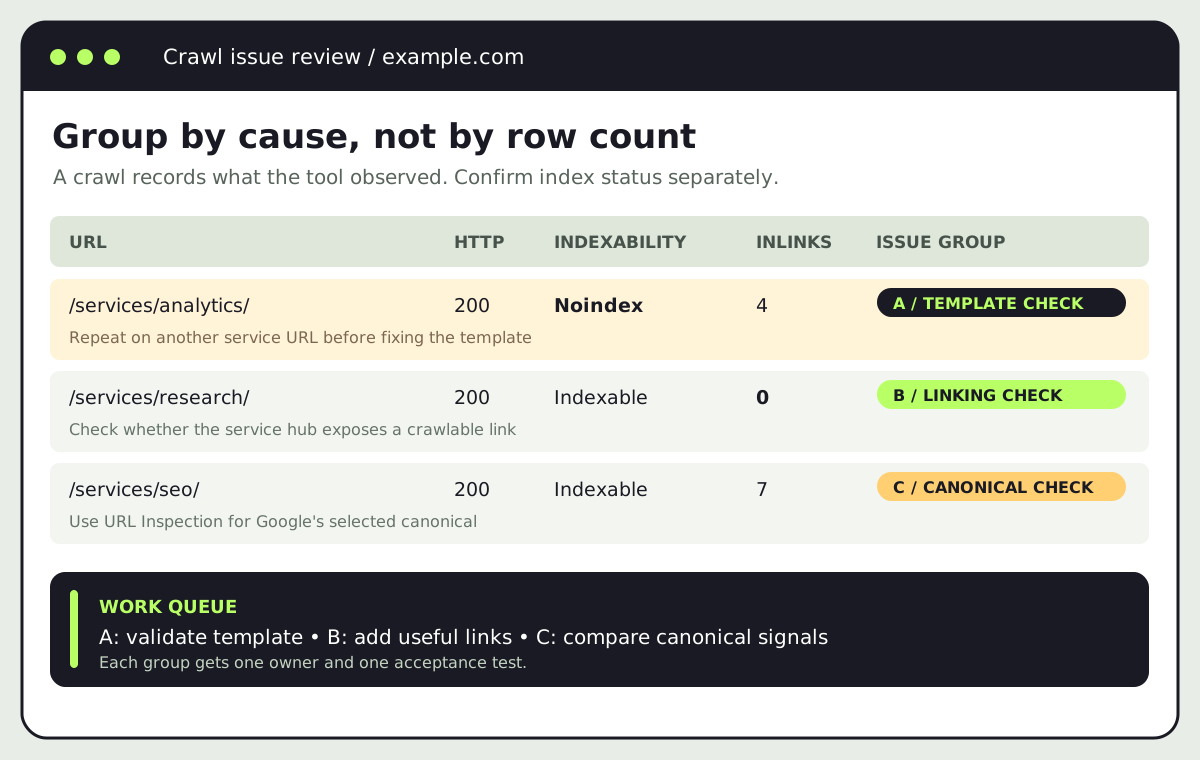
Illustrative crawl-export mock using example.com, not a live site scan.
Keep discovery and verification separate. A crawl can show what your tool received at a point in time. Search Console’s URL Inspection tool shows what Google knows about a specific URL and offers a live test. The two can disagree because a page changed after Google last crawled it. Record both states and the date before creating a fix ticket. A new page absent from a crawl may simply need a crawlable internal link; a new page absent from Google’s index is a different question.
Score the remaining work without pretending to forecast revenue
For issues that pass the gate, rate four inputs from 1 to 3. Use the same definitions in each weekly review:
- Business value (V): 3 for a core offer or high-intent category; 2 for a supporting page group; 1 for low-priority informational or utility pages.
- Relevant reach (R): 3 for a reusable template or many intended URLs; 2 for a small group; 1 for one low-scope page. Count only pages that should be in search, not every parameter or duplicate URL.
- Evidence confidence (C): 3 when the issue reproduces in a live test and the intended state is clear; 2 when signals are consistent but the cause needs confirmation; 1 when the finding is only a tool warning.
- Effort (E): 1 for a small, low-risk edit and retest; 2 for a moderate template or content change; 3 for a cross-system change or one that needs substantial QA.
Calculate V × R × C ÷ E, rounded to one decimal place. That arithmetic is only a sorting aid. It cannot estimate clicks or revenue; it also cannot replace the P0 gate or owner judgment. A 12 does not promise twice the impact of a 6. Review ties and close scores together, and downgrade any ticket whose evidence is still weak.
Here is a scored backlog for a hypothetical service site. All URLs and scores are examples, not Twigu or client findings.
| Root-cause ticket | V | R | C | E | Score | Queue decision |
|---|---|---|---|---|---|---|
A. Accidental noindex on the core service template | 3 | 3 | 3 | 2 | 13.5 | P0 gate: verify and fix before normal scoring |
| B. Three new service pages lack crawlable links from the service hub | 3 | 2 | 2 | 1 | 12.0 | Quick, valuable test after the blocker |
| C. Two service URLs have a disputed Google-selected canonical | 3 | 2 | 2 | 3 | 4.0 | Investigate page difference before changing tags |
| D. Mobile LCP is poor on a supporting page template | 2 | 2 | 2 | 3 | 2.7 | Schedule with UX and engineering evidence |
| E. Duplicate descriptions on low-priority archive pages | 1 | 1 | 2 | 2 | 1.0 | Defer unless another reason raises importance |
The chart plots business value × relevant reach against effort for the same example tickets. It shows why B is a good small-team candidate and why A still overrides the matrix. C and D need more investigation or implementation capacity; E should not displace an eligibility fix.
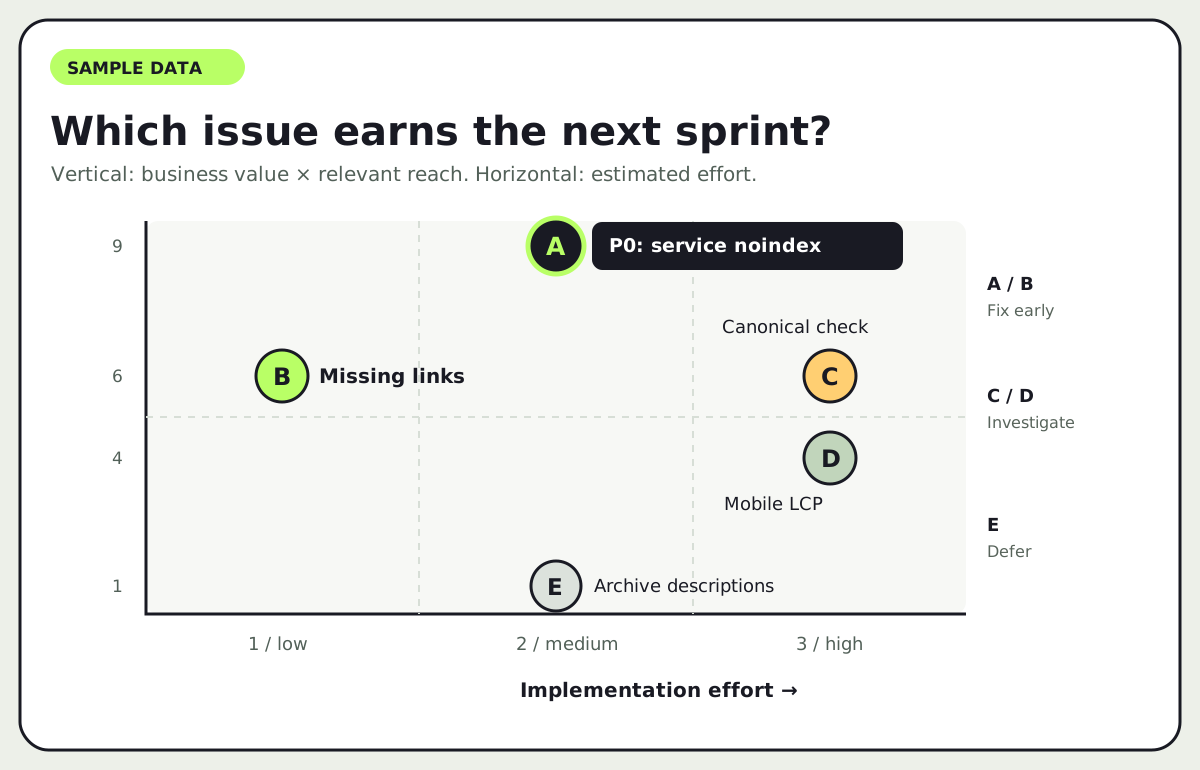
The score changes when evidence changes. If C turns out to be an intentional duplicate, remove it. If D affects the contact journey on every high-intent page, raise its business value. Google’s Core Web Vitals guidance treats loading, responsiveness, and visual stability as real-world user-experience measures. That makes speed worth improving, but not a reason to assume that every lab warning outranks a verified indexing blocker.
Work the first two tickets all the way to an outcome
A: accidental noindex. Choose one affected service URL and confirm its intended status. Inspect the live page and response headers, then compare Search Console’s indexed and live versions. If the template still sends noindex, remove the directive only from the pages intended for search. Test a representative service URL, a page that should remain excluded, and the built output after deployment. The acceptance test is not “tag removed from source code”; it is “the live intended URL no longer exposes noindex, while intentionally excluded URLs still do.” Google must be able to crawl a page to see a noindex directive, so do not try to fix this by blocking the page in robots.txt (Google’s noindex guide).
B: missing internal links. Open the service hub as a visitor and locate the three new pages. If they are absent from crawlable navigation or contextual links, add relevant links with descriptive anchor text where a buyer would expect them. Google’s SEO Starter Guide explains that crawlable links help discovery and that link text helps readers and Google understand the destination. Retest by crawling from the hub page and confirming the links lead to the intended canonical URLs. Do not add a sitewide footer link to every page merely to manufacture inlinks.
For C, do not start with a tag edit. Compare the two pages’ purpose, content, redirects, sitemap entries, and internal links; then inspect the Google-selected canonical. If the pages are effectively the same, consolidating may be right. If they serve distinct buyer needs, make that distinction clear before asking Google to reconsider. Canonical hints are signals, not commands.
Turn the matrix into a one-week operating rhythm
On Monday, capture the crawl and Search Console evidence and agree on the P0 list. On Tuesday, give each ticket a single owner and a reviewer. Midweek, implement one root-cause fix at a time. Before closing a ticket, test a representative affected page, an unaffected control page, the expected HTTP and indexability state, and the user path. Then record the deployment date so later Search Console data can be read in context.
Do not treat a report that has not refreshed as proof the fix failed. The Page indexing report can lag behind a live change; URL Inspection helps distinguish Google’s last recorded state from the current page. A live test can show an eligibility problem is fixed, but it does not guarantee the URL will be indexed. Keep the backlog status as fixed on site, awaiting recrawl rather than claiming an outcome you cannot yet observe.
This is a companion to Twigu’s 30-minute Search Console indexing audit, which explains how to diagnose individual URLs, and our 90-day SEO roadmap, which places technical work inside a broader growth plan. If a site-wide template or architecture issue needs deeper implementation, see Twigu’s SEO service for how we scope that work.
