
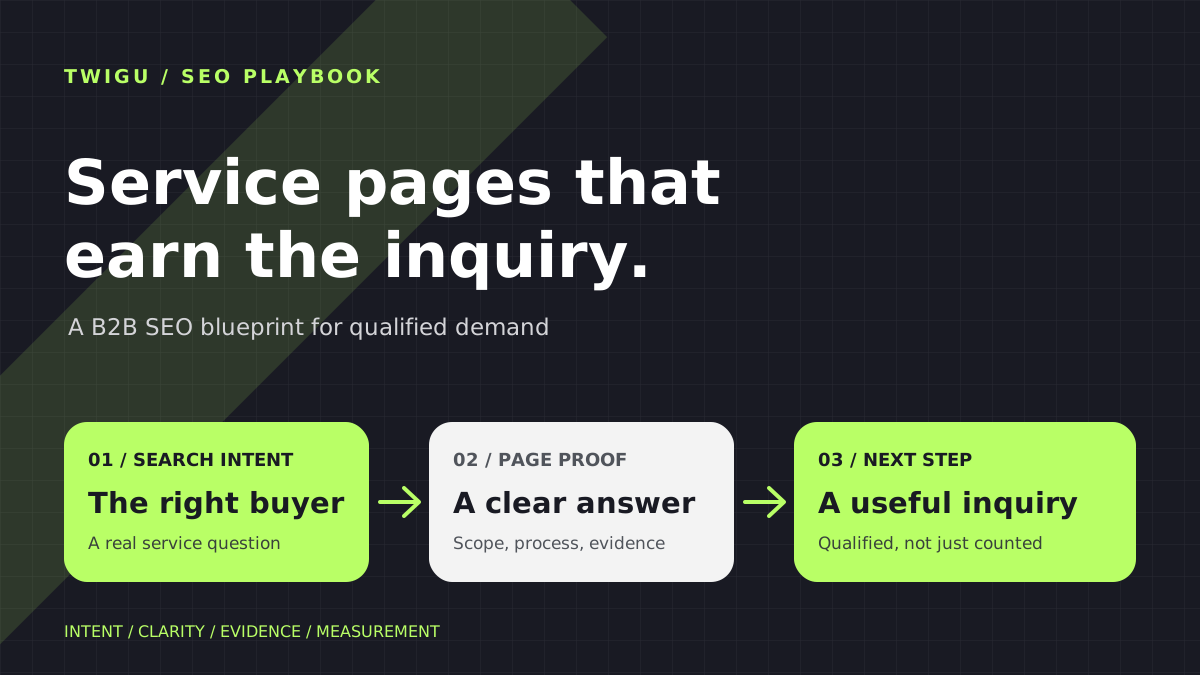
A B2B service page has two jobs. It must help the right buyer find the service, then give that buyer enough confidence to take a useful next step. Many pages do only one: they rank for broad terms but do not explain delivery, or they describe the company well but never answer the query that brought the visitor there.
This guide is for teams selling considered services such as logistics, software implementation, consulting, or marketing. It shows how to choose the right page, what to put on it, and how to tell whether the page creates qualified demand rather than just traffic.
Start with the buying question, not the keyword list
Before writing, interview sales or review actual inquiries. Ask which service the buyer requested, what constraint mattered, and what they needed to know before contacting you. A keyword tool can help estimate demand, but it cannot tell you whether a phrase represents a useful opportunity for your business.
Group queries by the decision a searcher is trying to make. For a freight-forwarding business, a useful map might look like this:
| Search pattern | Likely question | Best page | Next step |
|---|---|---|---|
freight forwarding services | Can this provider handle my shipment? | Core service page | Discuss a route or shipment |
air freight forwarding to Germany | Can they handle this route and mode? | Route or regional service page, if genuinely supported | Request a route assessment |
freight forwarding vs customs broker | Which service do I need? | Comparison guide | Move to the relevant service page |
how long does customs clearance take | What affects timing? | Informational article | Review the customs service |
Do not create a separate page for every slight wording change. Create a distinct page when the intent, service, audience, geography, or buying decision is materially different and you can provide information that a broader page cannot. Otherwise, strengthen the existing page.
Google’s SEO Starter Guide recommends logical site organization, useful content, descriptive URLs, and clear links between relevant pages. Those are good constraints for page architecture, not a reason to publish dozens of near-duplicates.
Make the page’s scope obvious in the first screen
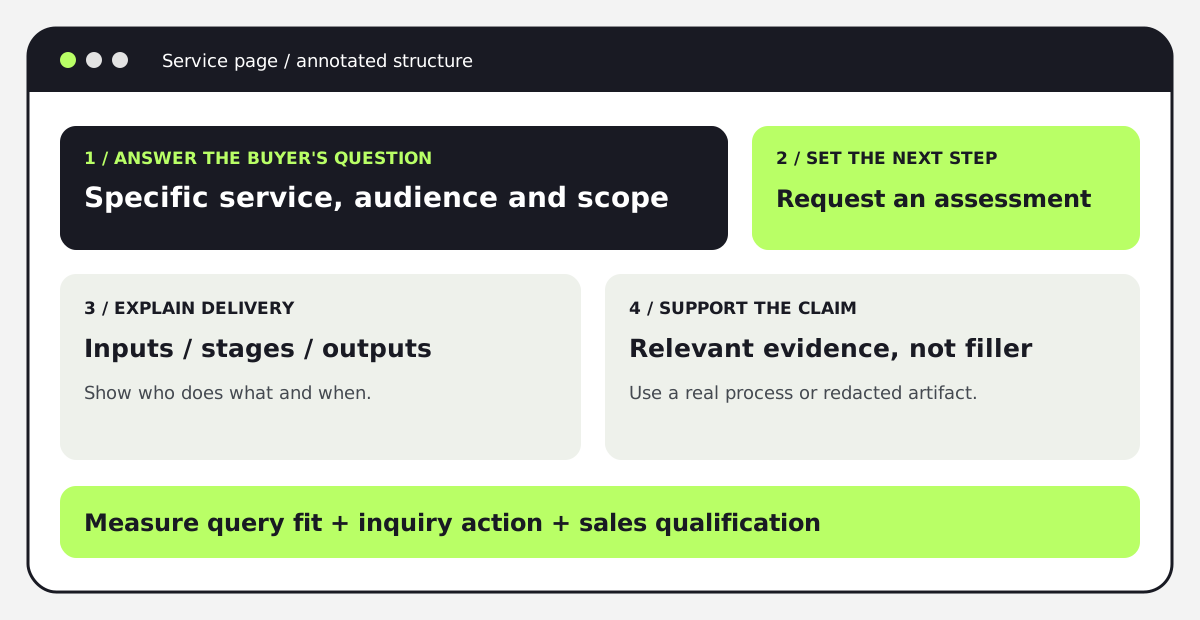
Within the first visible section, a buyer should understand four things: what you offer, whom it is for, where or when it applies, and what happens after they contact you. A vague headline such as “Solutions that move business forward” forces the visitor to work out whether they are in the right place.
A better opening for a logistics page would be: “Cross-border freight forwarding for manufacturers shipping between Europe and Central Asia.” The supporting paragraph can specify shipment types, the coordination model, and the next step. This is not a universal copy template; it works only if the company actually provides that route and service.
Keep the primary action close to the explanation. “Request a route assessment” tells the visitor what they will receive. “Submit” does not. If a consultation requires information first, name the minimum inputs: origin, destination, cargo type, expected volume, and target date. Avoid asking for a full procurement brief before a buyer has decided to speak with you.
The title tag should also describe the service clearly without stuffing variations. Google advises concise, descriptive titles, and may generate a different search-result title if the page signals conflict. Align the title, main heading, and visible offer rather than trying to force an exact phrase into every element.
Build proof into the explanation
Buyers need more than a list of capabilities. Explain the delivery sequence: discovery, implementation, handoff, reporting, or whichever stages are real for your team. For each stage, show the buyer what they provide, what you do, and what decision or deliverable comes next.
Good proof is specific and verifiable. Depending on the service, that might be a sample deliverable with sensitive data removed, a named certification, a redacted workflow screenshot, a real team role, a process diagram, or a case study that explains the problem and method. If confidentiality prevents you from showing client data, say so and label representative visuals or figures clearly. Never pass modeled numbers off as audited client outcomes.
The proof should appear near the claim it supports. If you promise market-specific execution, show how local research or review works. If you promise clean reporting, show the decision framework or the metrics the team reviews. A logo strip unrelated to the service is weaker than a concise explanation of how work is actually delivered.
Use the following page structure as a starting point, then remove sections the buyer does not need:
- Scope and fit: Service, audience, geography, and constraints.
- Problem and approach: The buying problem and how your work addresses it.
- Delivery detail: The stages, responsibilities, inputs, and outputs.
- Evidence: Relevant experience, case method, or a real work artifact.
- Commercial clarity: What affects price, timing, and project scope.
- Objections: Practical answers on integration, risk, or handoff.
- Next step: A low-friction action with a clear expectation.
Google’s people-first content guidance asks whether content adds original information and leaves readers with enough knowledge to achieve their goal. A service page should do that even if the visitor does not contact you today.
Connect supporting articles without cannibalizing the service page
The service page is the commercial destination. Supporting articles should answer narrower research questions and link back when the service becomes relevant. A guide to comparing freight modes should not duplicate the full freight-forwarding sales page. It should help readers make a choice, then point to the service that helps them execute it.
For an SEO agency, the same pattern applies: a core SEO service page explains the engagement, while an article such as our 90-day SEO roadmap addresses planning questions. The two pages should reinforce each other, not compete to answer the same query with slightly different words.
Use descriptive internal-link text. “See our SEO service and delivery model” is more helpful than “click here.” Add links where they help the reader continue a decision, not because a target number of internal links appears in a checklist.
Measure the path from query to opportunity
Rankings and sessions are diagnostic signals. They are not the final outcome for a B2B service page. Measurement needs a chain from search visibility to a qualified sales conversation.
| Layer | Question | Practical measure |
|---|---|---|
| Search demand | Is the page being found for relevant terms? | Search Console queries, impressions, clicks, country |
| On-page action | Did the visitor take a useful step? | Form start, form submit, call click, meeting-booking completion |
| Sales quality | Was the inquiry relevant and actionable? | Qualified lead status, service fit, market, deal stage |
| Business result | Did the page contribute to pipeline? | Opportunity value or won revenue, with attribution caveats |
Use Search Console’s performance data to inspect the actual queries and pages receiving Google Search traffic. In GA4, record meaningful actions as key events, then connect inquiries to your CRM or lead log. Test the form and event in a real browser before trusting the dashboard.
Keep the definitions stable. A newsletter signup is not the same as a qualified service inquiry. A call-button click is not the same as a completed call. If the team changes a form or CRM field, annotate the reporting so a sudden “improvement” is not just a measurement change.
For a simple operating review, compare each service page monthly on three axes: relevant query coverage, inquiry rate, and lead quality. A page with growing clicks but poor-fit leads needs a different fix from a page with high-fit leads but little search visibility. The first may need clearer scope or qualification; the second may need stronger indexing, internal links, or demand-aligned content. Our marketing measurement framework explains how to assign owners and review these signals without building a dashboard nobody uses.
Prioritize changes by the bottleneck
Avoid a blanket rewrite. Diagnose where the page fails, then make one class of changes at a time.
| Symptom | Check first | Likely action |
|---|---|---|
| Few relevant impressions | Indexing, intent fit, internal links | Clarify scope and connect the page to related content |
| Impressions but few clicks | Query mix, title, snippet, competing result types | Improve the search-result promise and page relevance |
| Visits but few inquiries | Offer clarity, trust, mobile form, CTA placement | Make the next step and proof more concrete |
| Many inquiries but poor fit | Page scope, offer wording, form fields | State exclusions and qualify the request |
| Good leads but weak opportunity rate | Sales handoff, response time, qualification rules | Fix the process after the form |
Do not interpret a low conversion rate without considering intent. A comparison article and a service page serve different stages of a buying journey. Compare like with like, and look at lead quality before optimizing for more form submissions.
A practical 30-day rollout
Week 1: Map. Pick one commercially important service. Review sales notes, Search Console queries, the current page, and direct competitors’ page structure. Write down the buyer’s decision, common objections, and the proof you can actually show.
Week 2: Draft. Rewrite the opening, delivery section, and next step. Add a concise FAQ only for questions sales hears repeatedly. Confirm every claim with the delivery team. If a number cannot be verified or disclosed, remove it or label it as representative.
Week 3: Publish and QA. Check the canonical URL, title, heading hierarchy, internal links, mobile layout, form behavior, and GA4 events. Ask a colleague unfamiliar with the service to explain the page after a one-minute read. If they cannot describe who it is for or what happens next, the page is not finished.
Week 4: Establish a baseline. Record Search Console query and page data, page-level engagement, inquiry count, and lead quality. Do not promise an SEO result in four weeks. This first measurement gives you a clean starting point for later decisions.
The final review question
Would a serious buyer know what you do, whether you can solve their specific problem, what evidence supports the claim, and what will happen after they contact you? If not, adding more keywords will not fix the page. Make the service understandable and credible first; then improve discoverability and measurement around that foundation.
If your team needs help connecting page architecture, search intent, and lead measurement, review Twigu’s SEO service or talk with us about the engagement.
